


From 10–12 June 2026, the National Assembly of Botswana and Inter Pares – Parliaments in Partnership convened parliamentarians and experts from across Africa and Europe to explore how parliaments can strengthen oversight of public finances and state-owned enterprises.
Through peer learning and comparative exchange, participants examined practical approaches to budget scrutiny, accountability, transparency, and evidence-based decision-making. Discussions highlighted the role of parliamentary committees, audit institutions, and independent fiscal analysis in strengthening oversight throughout the budget cycle.
The workshop reinforced the National Assembly's commitment to effective governance and demonstrated the value of parliamentary partnerships in advancing democratic accountability and institutional development.

Learning Across Borders: How Parliamentary Partnerships Strengthen Democracy (June 2026)
To mark International Day of Parliamentarism, Inter Pares highlights how peer-to-peer partnerships are helping parliaments strengthen democratic accountability and improve public financial oversight. Through a partnership between Nepal's Federal Parliament Secretariat and Ireland's Parliamentary Budget Office, parliamentary leaders and experts have exchanged experiences on building institutional capacity, supporting evidence-based decision-making, and strengthening budget scrutiny.
Workshops held in Kathmandu in May 2026 brought together parliamentarians, parliamentary staff, and international peers to explore the role of Parliamentary Budget Offices, parliamentary budget powers, and citizen participation in budget processes. The exchanges demonstrated how peer learning can help parliaments develop technical expertise, strengthen oversight institutions, and better align public spending with citizens' priorities.
The Nepal-Ireland partnership illustrates the value of parliamentary cooperation in addressing shared challenges and building stronger, more accountable democratic institutions through practical, experience-based learning.

Beyond the Plan: How Parliaments Can Turn Strategy into Stronger Democratic Institutions (May 2026)
Strategic planning may not be the first thing people associate with parliamentary democracy, but it is essential to effective, resilient institutions. Behind every parliament that can adapt, modernize, and deliver for citizens are the systems, leadership, and long-term planning that make that possible.
This blog highlights how as parliaments navigate rapid change, tighter resources, and growing pressure to strengthen public trust, strategic planning is no longer a back-office exercise -- it is a core democratic capability.
To support this work, Inter Pares, funded by the European Union, partnered with International IDEA and the National Assembly of Zambia to develop the new Guidelines on Parliamentary Strategic Planning -- a practical resource created by parliamentary practitioners, for parliamentary practitioners. The handbook emerged from the first High-level Workshop on Parliamentary Strategic Planning in Lusaka in 2025, where senior parliamentary officials from 11 parliaments across Africa, Europe, and North America shared candid lessons on what makes institutional reform succeed.
Grounded in real parliamentary experience, the guidelines help leaders and staff turn strategy into action by focusing on practical priorities: honest institutional assessment, shared ownership, realistic implementation, adaptive learning, effective communication, and peer exchange. With examples from Botswana, Canada, Denmark, Ghana, Namibia, Sierra Leone, Sweden, and Zambia, the resource offers practical insights for strengthening parliamentary resilience, effectiveness, and democratic performance.

Youth in Action: Inside Benin’s Parliamentary Academy (May 2026)
This blog highlights what happens when young people are given just 90 seconds to pitch their ideas to parliamentarians? In Benin, the result was a powerful demonstration of youth leadership in action.
At the Youth Parliamentary Academy, co-hosted by Inter Pares and the National Assembly of Benin, 72 youth leaders strengthened their advocacy, public speaking, and policy development skills through a hands-on training experience. The highlight: presenting 12 evidence-based policy pitches directly to senior parliamentarians in a rare moment of direct youth-to-parliament dialogue.
More than a training, the Academy created a meaningful pathway for young people to engage with decision-makers, amplify community concerns, and build confidence as civic leaders. Supported by the European Union, the initiative underscores how investing in youth participation can help strengthen more inclusive and responsive democratic institutions.

When People and Wildlife Collide: Why Parliaments Matter More Than Ever (February 2026)
This blog explores how human–wildlife coexistence has become a pressing governance challenge rather than a distant environmental issue. Drawing on insights from the International Parliamentary Roundtable on Human–Wildlife Coexistence held in Gaborone, Botswana, in January 2026, the blog highlights how communities across Africa—and increasingly Europe and Asia—are living daily with the impacts of wildlife on livelihoods, safety, and food security.
Bringing together parliamentarians, practitioners, civil society, and community representatives from Africa, Europe, and Asia, the roundtable emphasized that effective coexistence depends on strong parliamentary leadership, inclusive decision-making, fair compensation mechanisms, and laws grounded in lived experience. African approaches, particularly community-based natural resource management, offered valuable lessons for global policymakers, challenging traditional “north-to-south” knowledge flows. The blog underscores that sustainable coexistence is not about reducing wildlife, but about balancing human well-being, conservation, and accountability—making parliaments central to shaping solutions that work for both people and nature.

The New Playbook: Eight Ways Parliaments Can Rebuild Trust Through Citizen Engagement (November 2025)
Trust in democracy is declining worldwide, and parliaments — the essential link between citizens and state decision-making — are no exception. While citizen engagement is more critical than ever, practical, actionable guidance for how parliaments can effectively involve the public has been hard to find.
To meet this urgent challenge, International IDEA’s Inter Pares — Parliaments in Partnership project and the International Parliament Engagement Network (IPEN), with support from the European Union, co-created a series of eight interactive Guides on Citizen Engagement for Parliaments.
These guides are more than a resource; they are toolkits built on extensive global research, with the aim of shifting the focus from “citizens as spectators” to “citizens as active participants.” Recognizing that citizen engagement is core to democratic resilience, these guides offer a wide range of actionable, evidence-based frameworks for meaningful interaction, deliberation, and co-creation.
For members of parliament, parliamentary staff, civil-society and international development partners, and scholars, this suite provides a holistic roadmap for innovation, helping parliaments worldwide redefine their role in this challenging era. Read on to learn more about the guide series.

Not ‘Just Part of the Job’: How Parliaments Are Countering Violence Against Women in Politics (November 2025)
This blog examines the growing threat of violence and abuse against women in politics and its damaging impact on democratic representation. Drawing on data, high-profile cases, and parliamentary responses from across Europe and beyond, it shows how harassment, intimidation, and online abuse are driving women out of public life and deterring future generations from political participation.
Highlighting concrete actions taken by parliaments, the blog explores three key areas of response: making violence against women in politics visible, strengthening laws and policies and ensuring their enforcement, and creating safer parliamentary institutions. From mandatory training and legal reform to oversight, reporting mechanisms, and zero-tolerance workplace cultures, the blog demonstrates that violence is not “part of the job” — and that parliaments have both the responsibility and the tools to protect women leaders and strengthen democracy.

Cooperation in Action: Four Lessons from the First Inter-Parliamentary Strategic Planning Workshop in Zambia (October 2025)
For the first time, senior parliamentary staff from 11 countries across Africa, Europe, and North America gathered in Lusaka, Zambia for a groundbreaking Inter-Parliamentary Strategic Planning Workshop. Hosted by the National Assembly of Zambia (NAZ) and Inter Pares, with EU support, the event offered an unprecedented space for open, peer-to-peer dialogue on how parliaments can plan more strategically and strengthen democratic governance.
Participants explored four key lessons: the value of honest dialogue through innovative formats, the importance of fully integrated strategic plans, the role of monitoring and evaluation in democratic accountability, and the exemplary leadership of NAZ as both host and case study. The event laid the foundation for a new Global Handbook on Parliamentary Strategic Planning, designed to help parliaments worldwide build resilience, align with democratic values, and deliver on citizen expectations.
Partners in Progress: How Inter Pares Collaborates with Parliaments Around the World (June 2025)
Since 2019, Inter Pares has worked to strengthen democratic institutions through peer-to-peer collaboration between parliaments around the world. Funded by the EU and implemented by International IDEA, the program connects parliaments from Europe with counterparts in Africa, Asia, and Latin America to exchange knowledge and co-develop tools for better lawmaking, oversight, and citizen engagement.
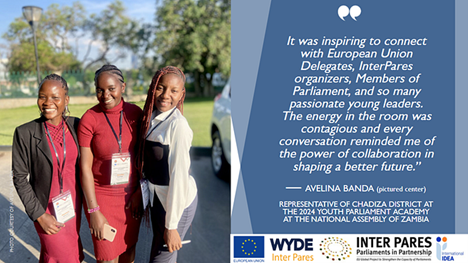
Marking the International Day of Parliamentarism, this blog highlights powerful examples of impact - from advancing evidence-based policy evaluation in Côte d’Ivoire, to empowering young citizens in Zambia through the Youth Parliamentary Academy, to supporting institutional reform in The Gambia. These stories show how peer learning and global cooperation are driving more inclusive, accountable, and resilient parliaments worldwide.

How Evaluation Brought Côte d’Ivoire and France Closer: With a little help from Inter Pares (May 2025) -
In the latest ModParl blog, POPVOX Foundation Fellow Beatriz Rey talks with Mónica Rico Benítez of Inter Pares about a remarkable partnership between Côte d'Ivoire and France transforming how public policies are evaluated.
The piece highlights how Côte d’Ivoire’s Parliament has taken a major step toward making its public policies more effective, thanks to a unique collaboration with France and support from the EU-funded Inter Pares program. Starting in 2021, this peer-to-peer partnership helped Côte d’Ivoire’s National Assembly and Senate transform newly created policy evaluation committees into functional, evidence-based bodies.
Through study visits, workshops, and tailored guidance, parliamentarians and staff learned how to assess real-world policy impacts — from regulating imported used cars to tackling illegal gold mining. The initiative strengthened coordination within Côte d’Ivoire’s Parliament, fostered accountability to citizens, and provided a model for cross-border learning that benefits both partners.
The next phase, launching in 2026, will focus on evaluating cross-cutting policies and sharing a public version of the guide to support parliaments worldwide in evidence-based decision-making.