

Strengthening Parliamentary Research: A New Peer-Learning Exchange Series between South Africa and Europe
From 5 November to 3 December 2026In partnership with the Parliament of the Republic of South Africa, Inter Pares – Parliaments in Partnership, part of the WYDE programme, funded by the European Union and implemented by International IDEA, has launched a series of peer exchanges bringing together parliamentary research and knowledge professionals from South Africa and European parliaments to explore how research, evidence and institutional knowledge can more effectively support parliamentary work.
The initiative will bring together representatives including parliamentary research and knowledge professionals from South Africa’s National Parliament and nine provincial legislatures, alongside counterparts from the parliaments of the Netherlands, Italy, Czechia, Slovakia and Austria, as well as the European Parliament.
The RSA Parliament Knowledge and Information Services Division (KISD) as well as Core Business Support Division supports Members and committees of the National Parliament in respect of research and knowledge management, while the South African Parliamentary Institute (SAPI), supported by the Legislative Sector Support Division (LSS), contributes to research, institutional learning and knowledge sharing across the South African Legislative Sector (SALS). Through virtual exchanges, participants will draw on the different experiences and institutional approaches of the participating parliaments to support learning and identify practices that may be adapted to their respective contexts.
Six areas for peer exchange
A series of thematic virtual exchanges from 5 November to 3 December 2026, provides a space for South African and European parliamentary colleagues to compare practices, examine concrete approaches and identify lessons that can be adapted to different institutional contexts. The exchanges will focus on six interconnected areas:
- Moving from reactive research to strategic knowledge support, including how parliamentary researchers can anticipate the future knowledge needs of committees and institutions.
- Making research more inclusive and participatory, including through lense of citizen, gender and youth perspectives as parliamentary evidence.
- Connecting research to the parliamentary cycle, looking at how different research products can support legislation, budgeting and oversight at the right moment.
- Strengthening knowledge brokerage, exploring how parliamentary services can draw effectively on universities, experts, think tanks and other external sources of knowledge.
- Using digital tools and AI while strengthening institutional memory, with attention to research quality, confidentiality, retrieval, reuse and human verification.
- Building stronger sector-wide research and knowledge systems, exploring what can be shared or coordinated across legislatures while maintaining strong research capacity close to Members and committees.
Understanding parliamentary research systems in practice
The virtual exchanges will provide a common foundation for further peer learning through two complementary study visits to European parliaments in the coming months.
The first study visit, involving Italy and the Netherlands, with a possible European Parliament component, will focus particularly on parliamentary research services in practice, including how research needs are identified, commissioned, produced, quality-assured and translated into useful support for Members and committees.
A second study visit to Slovakia and Czechia focuses particularly on the institutional design, governance, management and functions of parliamentary institutes and research services. The objective is to explore different organizational practices and choices relevant to strengthening research, knowledge management, and training across South Africa’s Legislative Sector.
This publication was funded by the European Union. Its contents are the sole responsibility of WYDE Inter Pares | Parliaments in Partnership and do not necessarily reflect the views of the European Union.
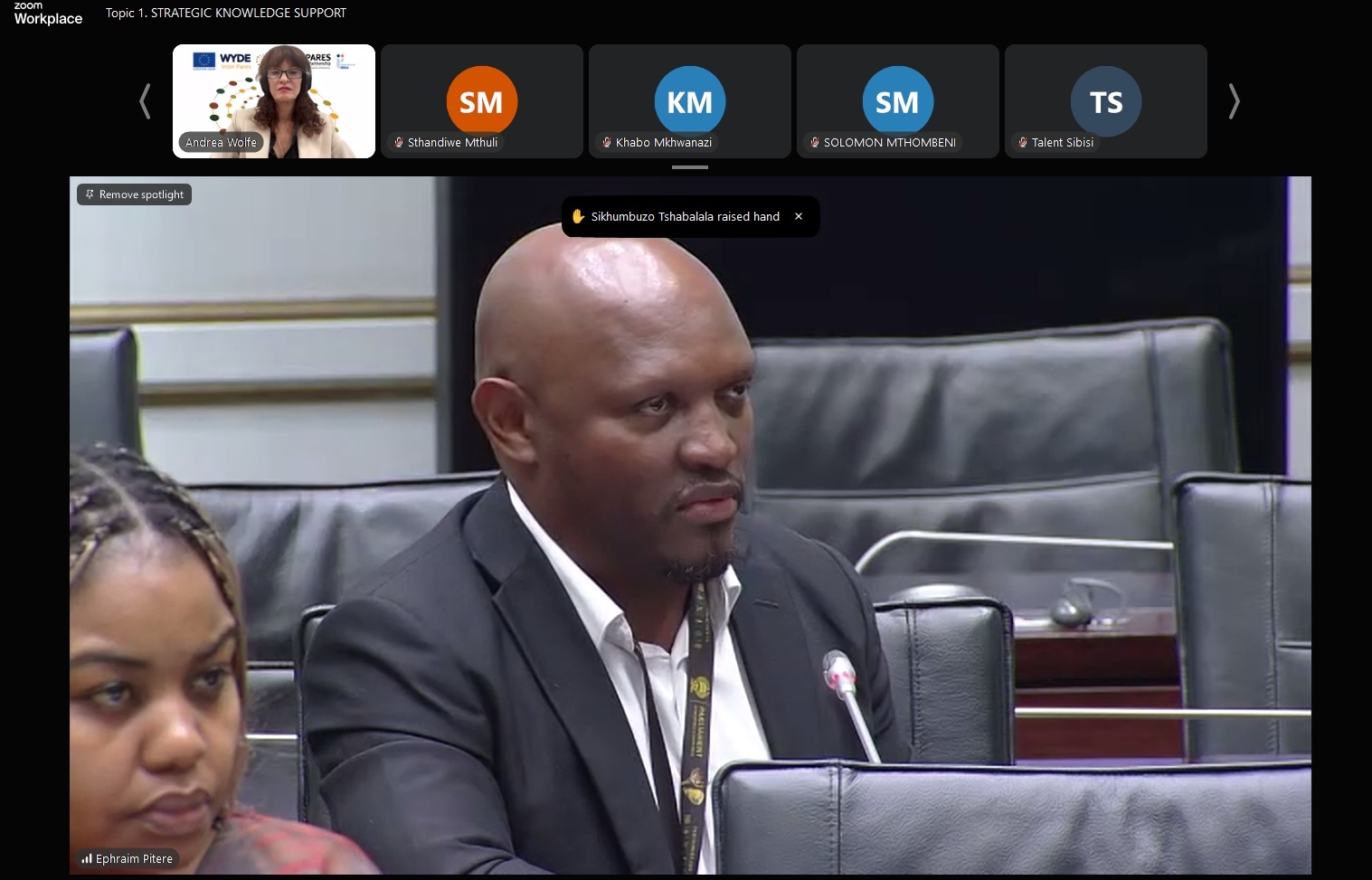
Participants in the 1st Virtual Exchange, “Moving from Reactive Research to Strategic Knowledge Support,” bringing together the Parliament of the Republic of South Africa, the Parliament of the Czech Republic, the National Council of the Slovak Republic, the House of Representatives of the Netherlands (Tweede Kamer), and Inter Pares | International IDEA.