
INTER PARES courses

INTER PARES | Parliaments in Partnership is the EU’s Global Programme to Strengthen the Capacity of Parliaments. INTER PARES will complement its in-person peer-to-peer exchange activities with online learning opportunities, hosted on the AGORA Portal.

The INTER PARES e-learning package comprises of six core courses (oversight; legislative drafting; comparative law-making; representation; budgeting and committee work) as well as a set of specialised courses, including gender and environmental protection and climate change.

Course list

Climate Change and Environmental Protection
Comparative Law-making
Human Rights
Legislative Drafting
Open Parliaments
Parliamentary Oversight
Parliaments in Practice
Representation
Técnica Legislativa
The Role of Parliament in Achieving Gender Equality
The Role of Parliament in the Budgeting Process

The Role of Parliamentary Committees
Youth Participation: Pathways for Parliaments
Go to course
Parliaments in Practice: an Introduction
Parliaments in Practice

This 'Parliaments in Practice: an Introduction' course is designed for legislators who are new to parliament, and for parliamentary staff, practitioners, donors, civil society organisations and others who want to learn about how parliament works.

Available in: en fr ar ru pt
Go to course
Técnica Legislativa
Técnica Legislativa

En los siete módulos del curso, se estudiarán:

  • El origen y evolución de la técnica legislativa
  • Las clases de normas de técnica legislativa
  • La técnica legislativa en la tramitación parlamentaria de las leyes
  • Los principios y reglas de la técnica legislativa
    • Sobre contenido y estructura de la ley
    • Sobre lenguaje legal
    • Sobre inserción de la ley en el ordenamiento jurídico

Este curso fue escrito por la Dra. Piedad García-Escudero Márquez, Catedrática de Derecho Constitucional Universidad Complutense de Madrid, Letrada de las Cortes Generales.”

This course offers a certificate.
NEW: Effective Human Rights Engagement for Parliaments
Human Rights

Building on the IDEA Inter Pares toolkit Effective Human Rights Engagement for Parliamentary Bodies, this course aims to provide those elected to or working in parliaments with the knowledge and skills necessary to effectively engage with human rights issues and promote active human rights engagement by their parliaments. Participants will learn about the role of parliament in promoting and protecting human rights, as well as the strategies, procedures and practices that promote effective human rights engagement. This course was written by Professor Kirsten Roberts Lyer, Central European University .

Go to course
Climate Change and Environmental Protection

At the end of this course, you will better understand: 

  • Why parliaments engage on climate change
  • The (international) legal framework
  • Parliamentary action on climate change
  • Climate budgeting and climate finance
  • Parliamentary practice on climate change

Throughout, you will be able to explore a wide range of case studies from across Europe and beyond.  

The course consists of 5 modules. Please click on the "Launch the learning module" in order to start the course

This course was written by former MP (New Zealand) Dr. Kennedy Graham.

This course offers a certificate.
Go to course
At the end of this course, learners will:
Youth Participation: Pathways for Parliaments

At the end of this course, learners will:

  • Have a better grasp of what youth participation is and is not;
  • Be familiar with existing models of youth participation;
  • Understand what youth participation could look like across the core parliamentary functions.

This course was written by Lotte Geunis, Parliamentary Adviser at INTER PARES and PhD Fellow at Maastricht University.

Go to course
The Role of Parliament in Achieving Gender Equality


Upon successful completion of this course, learners will be able to:

  • Identify the key texts that outline gender sensitive parliamentary norms
  • Identify, in their own parliamentary contexts, key decision makers and influencers that will support gender sensitive change
  • Critically assess the merits and applicability to their own parliamentary context of gender sensitive changes that have been adopted elsewhere
  • Design and defend a contextually-appropriate gender sensitive parliamentary change.
This course offers a certificate.
Go to course
The Role of Parliamentary Committees

Upon successful completion of this course, learners will be able to:

  • Understand why committees play an important role in parliamentary work;
  • Understand international practices and procedures of parliamentary committee systems; and
  • Be able to critically assess committee systems’ internal design choices, depending on their own country context.

This course was written by Dr. Tim Mickler, Leiden University (the Netherlands).

This course offers a certificate.
Go to course
The Role of Parliament in the Budgeting Process

This course provides learners with:

  • An overview of the core actors, institutions and processes involved in the budget process
  • An understanding of the role of parliament in each of the four budget stages
  • A snapshot of current trends in budgeting
  • A wide range of case studies, to illustrate how parliaments today are approaching the budget process
This course offers a certificate.
Available in: en es fr ar
Go to course
Comparative Law-making
This course analyses procedures and practices of law-making in contemporary democracies.

  • The first part places law-making among other parliamentary functions, underlining the close interrelationship and intertwining between the main features of the law-making process and the form of government.
  • The second part is devoted to parliamentary procedures for law-making and is divided into two sections: (a1) a historical approach, exploring the main models adopted in the UK, France and US (respectively, the Three Readings in the UK; the “‘Bureaux System”’ in France; and the Permanent Specialized Committees in the US), and (b2) a section focusing on a key driver of the transformation of law-making procedures: the growing complexity of legislation (‘complexification’), a key factor that is transforming contemporary law-making procedures.
  • The third and final part explores specific law-making practices through a comparative study of different jurisdictions.

This course was written by Professor Nicola Lupo, Libera Università Internazionale degli Studi Sociali.

This course offers a certificate.
Go to course
Parliamentary Oversight
  • At the end of this course, you will better understand:
  • Why we practice parliamentary oversight (theory)
  • What parliamentary oversight is and is not (the tools);
  • How parliamentary oversight is carried out (the practice);
  • The implications of parliamentary oversight (the politics);

Throughout, you will be able to explore a wide range of case studies from across Europe and beyond.

This course was written by Associate Professor Dr. Olivier Rozenberg, Sciences Po.

This course offers a certificate.
Go to course
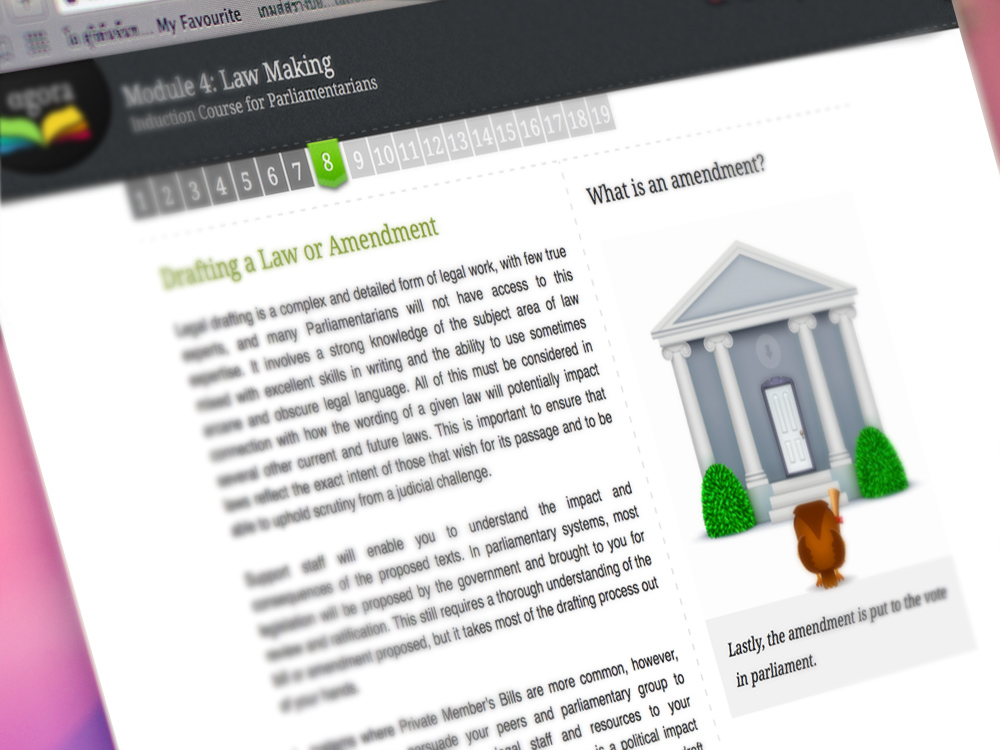
Legislative Drafting

Legislation constitutes the product of a lengthy process, beginning from a policy concept and ending with the realisation of the desired regulatory results

The legislative drafting process is part of the legislative (law-making) process, which in turn is part of the policy (governance) process.

The course consists of 8 modules. Please click on the "Launch the learning module" in order to start the course

This course was written by Professor Helen Xanthaki, University College London, with the support of Dr. Maria Mousmouti and Dr. Constantin Stefanou.

This course offers a certificate.
Go to course
Representation
Representation

At the end of this course, learners should have developed

  • Understanding of the key societal changes that have affected representation in recent decades;
  • Understanding of the key role played by modern parliaments in representation;
  • Knowledge and understanding of the five core processes of representation;
  • Ability to identify and critically evaluate examples of best practice in representation; and
  • Ability to critically reflect on their own practices of representation.

This course was written by Professor Cristina Leston-Bandeira, University of Leeds.

This course offers a certificate.
Available in: en es fr ar
NEW: Open Parliaments
Open Parliaments

At the end of this course, you will:

  • Have a good grasp of the core ideas behind transparency, accountability and participation in an open parliament context;
  • Have an overview of the evidence base and our evolving understanding of these issues;
  • Have a roadmap of possible actions you could take in your parliament, drawn from a wide range of insights and examples.

This course was written by Lotte Geunis, Senior Parliamentary Advisor, International IDEA